
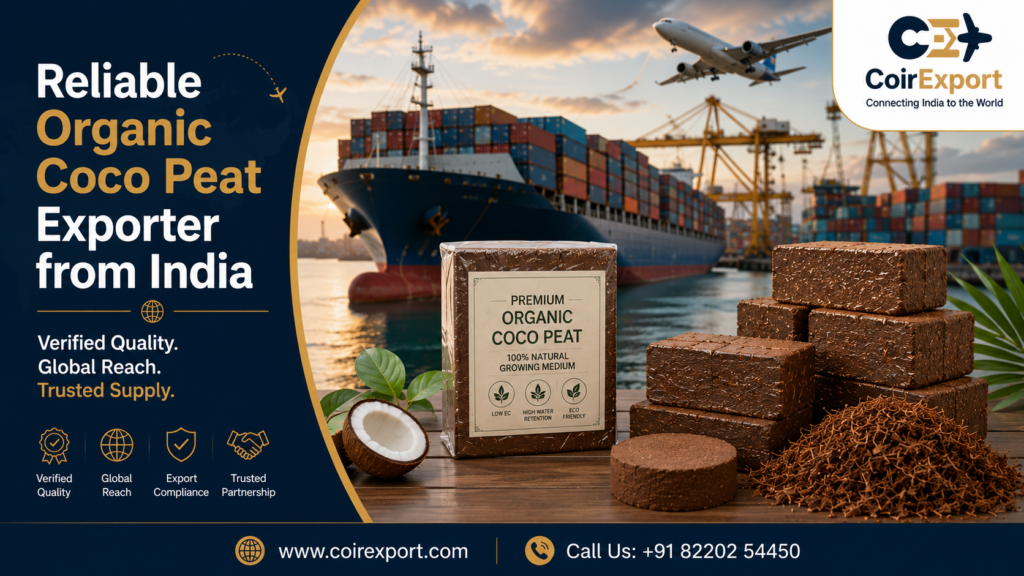
When global buyers search for a reliable organic coco peat exporter, they need far more than a product listing. Specifically, they need verified quality, consistent supply, and proper export documentation. They also need a sourcing partner who truly understands international trade.
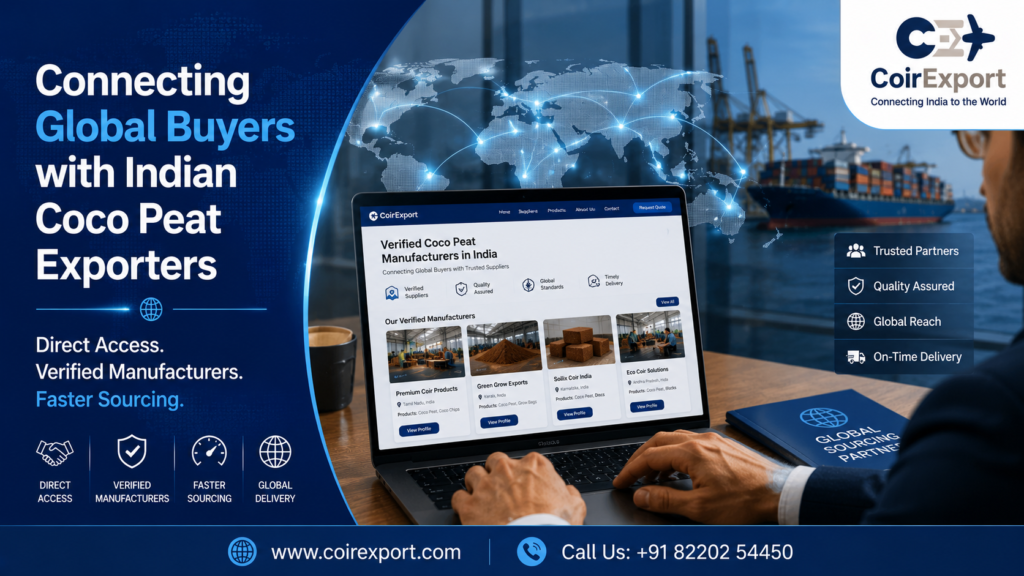
Coirexport, based in Chennai, Tamil Nadu, delivers precisely that. It is India’s dedicated B2B coir sourcing platform. Coirexport connects international buyers directly with the country’s most capable coir manufacturers through a transparent, fully verified directory.
India produces more than 80 percent of the world’s coir and coconut byproducts. As a result, coco peat has become one of India’s most valuable horticultural exports. Today, greenhouse farmers, hydroponic growers, landscapers, and nursery operators across Europe, the United States, the Middle East, and Southeast Asia actively source this material from Indian exporters.
In this guide, you will learn what organic coco peat is. You will also discover why buyers worldwide prefer India’s product, which grades are available, and how Coirexport makes sourcing faster and more transparent.
What Is Organic Coco Peat and Why Does It Matter?
Coco peat is a 100 percent natural, biodegradable growing medium. Manufacturers derive it from the fibrous husks of mature coconuts. During coir fibre extraction, processors separate the husk into long bristle fibres and the spongy pith between them. After washing, drying, and processing, that pith becomes coco peat or coir pith.
Moreover, organic coco peat stands out because of its environmental profile. Since it is a byproduct of an existing agricultural process, producers need no additional land or water specifically for its creation. Furthermore, using coco peat diverts coconut husk waste from open burning or landfill. This outcome directly supports sustainability mandates shaping procurement decisions across Europe, Australia, and North America.
Key Agronomic Properties of Organic Coco Peat
- High water retention: Coco peat holds up to 8 to 10 times its own weight in water. As a result, growers reduce irrigation frequency by 30 to 50 percent.
- Superior aeration: Its fibrous structure maintains air pockets around root zones. This prevents compaction and promotes healthy root development.
- Natural pH range: Quality washed coco peat holds a pH between 5.8 and 6.8. This suits most horticultural crops without additional amendment.
- Biodegradable and renewable: Unlike peat moss from finite bog ecosystems, coco peat is a renewable resource. It carries a significantly smaller ecological footprint.
- Reusable across cycles: Growers can reuse high grade buffered coco peat for two to three growing cycles. Consequently, input costs per crop reduce significantly.
- Naturally weed free: Properly processed coco peat carries no weed seeds, pathogens, or harmful nematodes. Therefore, it is a clean input for certified organic farming.
Why Global Demand for Organic Coco Peat Keeps Rising
These properties collectively explain why demand from Indian exporters has grown consistently over the past decade. In particular, buyers in the Netherlands, Germany, the United Kingdom, the United States, Japan, and the UAE increase their import volumes every year. Additionally, newer markets in Southeast Asia and the Middle East now adopt coco peat at scale. Protected agriculture is expanding rapidly across both regions.
Organic Coco Peat Grades Available Through Coirexport
Not all coco peat is the same. The grade, electrical conductivity (EC) level, and physical form together determine the right end application. Therefore, Coirexport connects buyers with Indian manufacturers that supply the full spectrum of grades. Every listing is verified for quality and consistency.
| Grade | EC Level | Best For | Form |
|---|---|---|---|
| Raw / Unwashed | Above 1.0 mS/cm | Industrial use, soil blending | Loose / Block |
| Washed Grade | Below 0.5 mS/cm | General horticulture, nurseries | Block / Disc |
| Buffered Grade | Below 0.5 mS/cm | Hydroponics, precision farming | Slab / Block / Grow Bag |
| Triple Washed | Below 0.3 mS/cm | Sensitive crops, tissue culture | Block / Disc |
The Buffered Grade: Top Choice Among Coco Peat Exporters
The buffered grade is the most widely imported variety. Commercial hydroponic and greenhouse operations prefer it for tomato and pepper cultivation. Buffering treats washed coco peat with calcium nitrate. This displaces excess potassium and sodium ions. Consequently, it prevents nutrient lockout in the growing system. Coirexport’s verified suppliers provide buffered coco peat in compressed blocks, slabs, and grow bags. They include documented EC and pH test results with every shipment.
Product Forms That Verified Organic Coco Peat Exporters Supply
Compressed Coco Peat Blocks
Compressed blocks are the most common export form. Manufacturers compress them to a standard 650 gram or 5 kilogram weight. Each block expands to 8 to 12 litres upon rehydration. Because they are compact and lightweight, they palletise efficiently. This therefore reduces freight costs significantly. Coirexport’s network produces blocks to international specifications including 30x30x10 cm and 20x10x5 cm standard sizes.
Coco Peat Grow Bags
Grow bags are prefilled, sealed polyethylene bags of processed coco peat. Growers use them as ready to plant systems in greenhouse and polytunnel environments. Manufacturers offer standard sizes for tomatoes, strawberries, cucumbers, herbs, and peppers. Coirexport lists agri grow bag manufacturers with full specification sheets. This helps commercial greenhouse buyers evaluate options before ordering.
Coco Peat Discs and Plugs
Compressed discs and plugs serve seed germination and transplanting applications. Each disc expands into a small growing pot when growers add water. Professional nurseries and retail garden centres widely use these formats. Indian manufacturers in the Coirexport network supply discs in biodegradable net pots or loose formats.
Loose Coco Peat
Uncompressed loose coco peat ships in 25 kilogram or 50 kilogram bags. Buyers use it for blending into potting soil mixes, turf preparation, and landscaping. Indian suppliers in Tamil Nadu and Kerala produce loose pith with consistent particle size and low EC. Buyers can therefore use it immediately after arrival.
Coco Peat Seedling Trays
Multi cell seedling trays allow nurseries and forestry operations to propagate seedlings at scale. Since these trays are 100 percent biodegradable, growers plant them directly into the ground. The root system stays fully intact. Coirexport lists manufacturers of seedling trays for both domestic and export markets.
Why Coirexport Stands Apart as an Organic Coco Peat Exporter Platform
Coirexport is not a trading company or a single manufacturer. Instead, it is India’s dedicated B2B sourcing platform for the coir industry. It connects international buyers with a verified network of certified Indian manufacturers and exporters. This distinction matters because it directly affects the quality of every supplier relationship.
Verified Listings of Trusted Organic Coco Peat Exporters
Every organic coco peat exporter on Coirexport has been reviewed for product capability, export documentation, and certification status. As a result, buyers deal directly with the manufacturers who process and pack the product. They do not deal with unverified brokers or agents who add cost without adding value.
Transparent Specifications from Certified Coco Peat Exporters
Coirexport provides downloadable product specification sheets for each listed product. For organic coco peat, these sheets cover EC values, pH range, moisture content, compression ratio, and packaging dimensions. Therefore, international buyers compare specifications against their own procurement standards before initiating contact.
Export Documentation Support Across All Key Markets
Organic coco peat shipments require a Phytosanitary certificate from India’s National Plant Protection Organisation (NPPO). They also require compliance with the importing country’s biosecurity regulations. In many cases, organic certification documentation is required too. Because Coirexport’s verified exporters handle shipments to the EU, USA, Australia, Japan, and the Middle East routinely, they prepare these packages efficiently.
Direct Buyer to Seller Communication
Coirexport’s direct connect service removes the intermediary layer entirely. Consequently, buyers communicate directly with the manufacturing unit. They negotiate pricing transparently and request samples without routing through agents. This approach reduces procurement lead time significantly. It also gives both parties a strong foundation for long term trading relationships.
Ready to source? Request your free quote at coirexport.com and receive verified supplier matches within 24 hours.
What Separates a Genuine Organic Coco Peat Exporter from a Generic Supplier
The global coco peat market has no shortage of suppliers. However, it consistently lacks reliable differentiation. Buyers who source from unverified suppliers frequently report high EC values that damage crops. They also report inconsistent compression ratios and missing phytosanitary certificates. Therefore, understanding what a genuine organic coco peat exporter delivers is critical before any commitment.
Third Party Tested Results: The Mark of a True Coco Peat Exporter
A verified organic coco peat exporter from India provides independent laboratory test reports for each batch. These are not just internal measurements. For example, consistent EC below 0.5 mS/cm for washed grades represents the industry benchmark. Professional buyers should always insist on these third party results.
Organic Certification Where Buyers Require It
Buyers who supply certified organic farms need coco peat that meets organic input standards. This applies particularly in the EU and North America. Accordingly, Coirexport’s network includes manufacturers that hold relevant certifications from recognised bodies. ECOCERT and Control Union are examples. This enables buyers to maintain their own organic compliance without interruption.
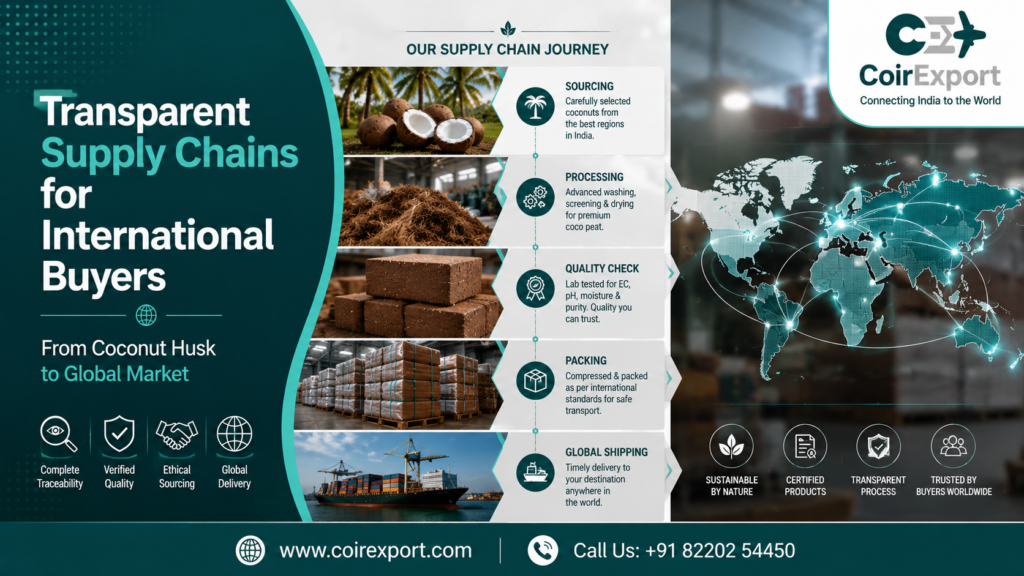
Traceable Supply Chains for Institutional Buyers
Institutional and retail buyers increasingly need supply chain transparency. They want to know which processing unit produced the coco peat. They also want to know which coconut growing region supplied the husks. Consequently, Coirexport’s verified manufacturer model provides this level of visibility. Generic traders simply cannot offer this.
International Standard Packing That Protects Product Integrity
Export quality coco peat blocks must withstand ocean freight without losing compression integrity. Verified Indian manufacturers in the Coirexport network use heat sealed polyethylene inner wrap. They pack this with jute or HDPE outer sacking and palletise to standard ISO dimensions. This ensures buyers receive product in exactly the same condition it left the factory.
Global Markets That India’s Organic Coco Peat Exporters Serve
India’s organic coco peat reaches buyers across multiple continents. Each region brings distinct requirements that experienced exporters must understand and meet.
- Europe (Netherlands, Germany, UK, Spain): The world’s largest greenhouse vegetable sector relies on coco peat grow slabs and blocks. Consequently, buyers require buffered, low EC product with full EU biosecurity compliance.
- United States and Canada: Professional horticulture operations, cannabis cultivators, and nursery producers actively source Indian coco peat. These buyers require clean documentation and consistent sizing.
- Middle East (UAE, Saudi Arabia, Jordan): Hydroponic farming is expanding rapidly because of land and water constraints. As a result, demand for compressed blocks and grow bags is strong and growing.
- Australia and New Zealand: Strict biosecurity laws mean Phytosanitary certification and heat treatment documentation are both mandatory. Coirexport’s verified exporters prepare documentation accordingly.
- Japan and South Korea: These markets demand premium grade coco peat for speciality horticulture and retail. Buyers require precise specifications, which verified Coirexport suppliers reliably deliver.
- Southeast Asia (Thailand, Vietnam, Indonesia): Regional demand for coco peat grow bags and loose pith is growing steadily as protected agriculture expands.
Frequently Asked Questions
Q1. What Is the Difference Between Washed and Buffered Organic Coco Peat?
Washed coco peat goes through a rinsing process that reduces sodium and potassium content. This brings EC below 0.5 mS/cm. Buffered coco peat then undergoes an additional treatment with calcium nitrate. This replaces residual potassium ions with calcium. As a result, the growing medium becomes chemically stable. Therefore, growers running hydroponic or greenhouse operations should always specify buffered grade.
Q2. What Certifications Should an Organic Coco Peat Exporter Provide?
At minimum, a reputable exporter should supply a Phytosanitary certificate from India’s NPPO, a Certificate of Origin, and a batch test report covering EC, pH, and moisture content. Additionally, buyers who supply certified organic farms may need input certification from a recognised body such as ECOCERT or Control Union. Coirexport’s verified exporters can supply all necessary documentation for every major importing market.
Q3. What Is the Minimum Order for Coco Peat Export from India?
For compressed coco peat blocks, the standard minimum order is typically one full container load (FCL). This accommodates approximately 2,000 to 2,500 units of 5 kg blocks. However, Coirexport’s direct connect service can arrange smaller trial orders for first time buyers. Simply submit a quote request with your quantity and destination. A sourcing specialist will then provide an accurate freight and pricing estimate.
Q4. How Long Does Shipping Organic Coco Peat from India Take?
Ocean freight transit from Indian ports such as Chennai or Tuticorin typically takes 18 to 25 days to Northern European ports. Transit to US East or West Coast ports takes 25 to 35 days. Furthermore, Coirexport’s sourcing specialists connect buyers with manufacturers who hold established relationships with freight forwarders. This ensures competitive rates and reliable scheduling.
Q5. Is Organic Coco Peat Suitable for Certified Organic Farming?
Yes. Coco peat that producers create without synthetic chemical treatment qualifies as an approved growing input under most organic farming standards. This includes the EU Organic Regulation and USDA NOP. India’s coco peat manufacturing industry includes a growing number of organically certified processors. Coirexport can specifically match buyers with these certified manufacturers.
Q6. Can Buyers Request Samples from a Coco Peat Exporter?
Conclusion
Absolutely. Sample requests are a standard part of the procurement process at Coirexport. Once a buyer submits an inquiry specifying the grade, form, and intended application, the matched supplier dispatches a courier sample with accompanying test reports. This step ensures full product suitability before the buyer commits to a container order.
Sourcing organic coco peat from India does not have to be complicated. Coirexport brings together verified manufacturers, transparent product specifications, and direct buyer to seller communication in one dedicated platform. Whether you need washed blocks, buffered grow bags, or triple washed discs, the right supplier is ready for you. Visit coirexport.com today and request your free quote.