
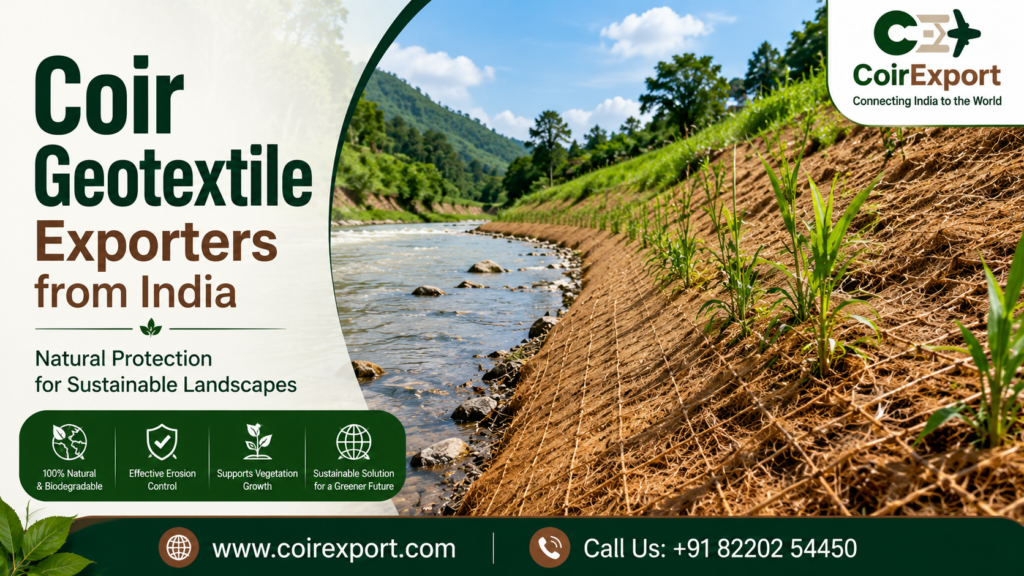
Currently, coir geotextile exporters from India lead a fast growing global shift toward biodegradable, natural fiber based erosion control solutions. As governments, civil engineers, and environmental planners move away from synthetic geotextiles, demand for coir based alternatives has surged across Europe, North America, Australia, and Southeast Asia. Consequently, India now holds the strongest position in this market of any country in the world.
Indeed, India accounts for more than 70 percent of global coir fiber production and ships products to over 121 countries. Therefore, sourcing directly from verified coir geotextile exporters in India gives international buyers the best combination of quality, traceability, and cost efficiency available anywhere. Moreover, CoirExport.com is India’s dedicated B2B platform connecting buyers with certified manufacturers across Tamil Nadu, Kerala, Karnataka, and Andhra Pradesh.
Many international infrastructure buyers prefer coir geotextile exporters from India because of their manufacturing scale, export experience, and technical compliance standards.
What Is Coir Geotextile and Why Is Global Demand Rising?
Broadly speaking, coir geotextile is a permeable, flexible fabric that manufacturers produce from natural coconut fiber. Furthermore, they offer it in both woven and non woven formats, and civil engineers use it extensively in landscaping, slope stabilization, and environmental rehabilitation projects. Specifically, it suits any project that requires ground stabilization during vegetation establishment.
Unlike synthetic materials such as polypropylene or polyester, coir geotextile is 100 percent biodegradable and breaks down naturally over three to five years. As it decomposes, it enriches the soil and leaves no harmful residue. Therefore, it has become the preferred choice for eco sensitive infrastructure and government mandated green projects globally.
Why Buyers Choose Coir Geotextile Over Synthetic Alternatives
| Property | Coir Geotextile |
| Material Source | 100% natural coconut fiber |
| Biodegradability | Fully biodegradable in 3 to 5 years |
| Soil Enrichment | Decomposes and adds organic matter to soil |
| Tensile Strength | Retains up to 20% strength after one year |
| UV Performance | Naturally absorbs solar radiation like soil |
| Vegetation Support | Promotes root establishment and seed germination |
| Environmental Impact | Zero synthetic residue, zero plastic pollution |
| Application Range | Slopes, riverbanks, roads, embankments, mines |
Furthermore, the European Union’s push for sustainable infrastructure has made coir geotextile a specification requirement on many national projects. As a result, buyers in Germany, the Netherlands, and Scandinavia now actively seek certified Indian exporters as their primary supply partners. Similarly, North American and Australian project owners increasingly write coir geotextile into their environmental engineering specifications.
Types of Coir Geotextile That Indian Manufacturers Supply
Specifically, coir geotextile exporters from India manufacture three primary product categories. To begin with, each type addresses distinct civil engineering and erosion control applications, so buyers must understand the differences before they place an order. Consequently, selecting the wrong product type can reduce project performance significantly.
1. Woven Coir Geotextile Mesh Matting
Notably, woven coir geotextile emerges from interlacing coir yarns on handlooms or powerlooms at fixed intervals. Therefore, the density of the weave determines the GSM rating, which ranges from 350 GSM to 1250 GSM depending on project requirements. Specifically, engineers deploy higher GSM fabrics on steeper slopes and in high velocity water flow environments.
Moreover, mesh openings in woven coir geotextile allow vegetation to grow through the fabric while the coir structure holds topsoil firmly in place. As a result, this dual function of erosion control and vegetation promotion forms the primary commercial advantage of woven coir geotextile in bioengineering projects. Additionally, woven formats offer higher tensile strength than non woven alternatives.
2. Non Woven Coir Geotextile Blankets
In contrast to woven formats, non woven coir geotextile comes from needle punching or thermal bonding of coir fibers without a structured weave. Furthermore, contractors use these blankets primarily for surface erosion control on gentle slopes, stream banks, and newly seeded areas. Consequently, they retain moisture at the surface level, which improves seed germination rates in arid and semi arid regions.
3. Coir Logs and Fiber Rolls
Additionally, coir logs are dense, cylindrical rolls of coir fiber that manufacturers wrap in a coir mesh netting. Therefore, project teams install them along stream banks, shorelines, and wetland restoration sites to reduce wave energy, trap sediment, and create conditions for emergent vegetation to establish. Specifically, diameters range from 20 cm to 50 cm, with lengths of 3 m to 6 m per unit.
Key Specifications That Define Export Grade Coir Geotextile
Before placing an order, international buyers should verify documented technical standards from any supplier. Specifically, those procuring for government infrastructure or certified environmental programs must confirm GSM, tensile strength, and open area percentage. Therefore, the table below outlines the core specifications that separate standard supply from export grade production.
| Specification | Standard Range | Premium Export Grade |
| GSM (Density) | 400 to 700 GSM | 700 to 1250 GSM |
| Roll Width | 1 m to 2 m | Up to 4 m (custom) |
| Roll Length | 10 m to 50 m | Up to 120 m (custom) |
| Tensile Strength (warp) | Minimum 4 kN/m | Above 8 kN/m |
| Tensile Strength (weft) | Minimum 3 kN/m | Above 6 kN/m |
| Open Area Percentage | 40% to 65% | Specified per project |
| Biodegradation Period | 3 to 5 years | Adjustable via treatment |
| Fiber Purity | Natural coir fiber | 100% virgin coconut fiber |
| Moisture Absorption | High | Tested and documented per batch |
Consequently, export grade manufacturers issue a Certificate of Analysis per production batch covering tensile strength, GSM tolerance, moisture content, and open area ratios. Therefore, buyers should always request batch specific documentation rather than generic brochure data. Moreover, suppliers who cannot provide batch level COA documentation present a significant quality risk on repeat orders.
Global Markets Served by Coir Geotextile Exporters from India

Currently, India ships coir geotextiles to over 121 countries worldwide. As a result of India’s production scale and established export infrastructure, buyers across every major region rely on Indian manufacturers as their primary or secondary supply source. Furthermore, the table below maps key importing regions to their specific application contexts.
| Region | Primary Application Context |
| European Union | Road embankments, riverbank stabilization, green infrastructure procurement |
| United Kingdom | Coastal erosion control, motorway slope protection, ecological restoration |
| United States and Canada | Mine reclamation, highway slope erosion, wetland restoration projects |
| Australia and New Zealand | Bushfire rehabilitation, land degradation reversal, watershed protection |
| Middle East | Wadi channel protection, desert landscaping, infrastructure slope stabilization |
| Southeast Asia | Flood prone riverbank protection, mangrove restoration, paddy field bunding |
| Africa | Reforestation slope protection, road embankment control, rural drainage projects |
According to India’s coir industry data, total coir and coir product exports reached USD 526.31 million in 2021 to 2022. Specifically, geotextiles now form a growing share of that figure, since global infrastructure projects increasingly specify biodegradable materials over synthetic alternatives. Therefore, demand from international buyers continues to rise year on year.
How to Identify Genuine Coir Geotextile Exporters from India
Notably, the Indian market for coir geotextile exporters includes both direct manufacturers and trading intermediaries. However, for buyers seeking consistent quality and competitive pricing, identifying genuine manufacturers is essential. Consequently, here is what separates verified exporters from brokers and aggregators in this market.
Production Ownership of Coir Geotextile Exporters from India
First, genuine exporters operate their own weaving and processing infrastructure, including handloom or powerloom weaving facilities and fiber preparation units. Therefore, manufacturers with owned production can guarantee product specifications. Moreover, they can fulfill repeat orders at the same quality level without relying on third party producers.
Export Documentation Used by Coir Geotextile Exporters from India
In addition, verified Indian exporters hold an IEC from the Directorate General of Foreign Trade. Furthermore, they manage phytosanitary certification requirements, fumigation documentation, and Incoterms compliance for FCL and LCL shipments. Consequently, exporters who rely entirely on freight agents for documentation create serious risk on large or time sensitive orders.
Product Certifications for Coir Geotextile Exporters from India
Specifically, export-grade coir geotextile from India may carry ISO 9001 certification for manufacturing process quality. Additionally, MSME registration confirms Indian government recognition of the producer. Furthermore, Coir Board of India registration validates the manufacturer as a genuine participant in India’s regulated coir industry.
Batch Traceability Standards of Coir Geotextile Exporters from India
Finally, leading exporters maintain lot wise production records that trace each roll back to its weaving date, fiber batch, and quality inspection record. Therefore, institutional buyers in Europe and North America increasingly require this traceability. Specifically, they must document the full supply chain for environmental certification purposes, so batch records are non negotiable.
Many international infrastructure buyers prefer coir geotextile exporters from India because of their manufacturing scale, export experience, and technical compliance standards.
What Expert Suppliers Deliver That Average Exporters Do Not
Indeed, the difference between expert coir geotextile exporters and standard suppliers goes far beyond price. Specifically, the gap becomes most visible across multiple shipments, project phases, and different technical specifications. Therefore, buyers who evaluate suppliers only on initial pricing often face quality issues on repeat orders.
| Expert Coir Geotextile Exporter | Average Supplier |
| Provides GSM-certified rolls with batch COA for every shipment | Supplies rolls without verified GSM documentation |
| Customizes roll width, length, and mesh density to project spec | Offers fixed standard sizes only |
| Manages end-to-end export logistics including phytosanitary compliance | Hands over product ex-factory only |
| Maintains consistent quality across 6, 12, and 24-month order cycles | Quality varies between first sample and repeat orders |
| Offers woven, non-woven, and coir log formats from a single source | Specializes in one product type only |
| Provides GSM guidance by slope angle, soil type, and water velocity | No technical guidance provided post-sale |
For example, civil engineering buyers often need GSM guidance by slope gradient, soil type, and water velocity condition. Consequently, expert exporters provide this application support as part of their standard commercial relationship. Therefore, choosing a technically capable manufacturer protects project performance across the full installation life of the geotextile.
How CoirExport.com Connects Buyers with Coir Geotextile Exporters from India
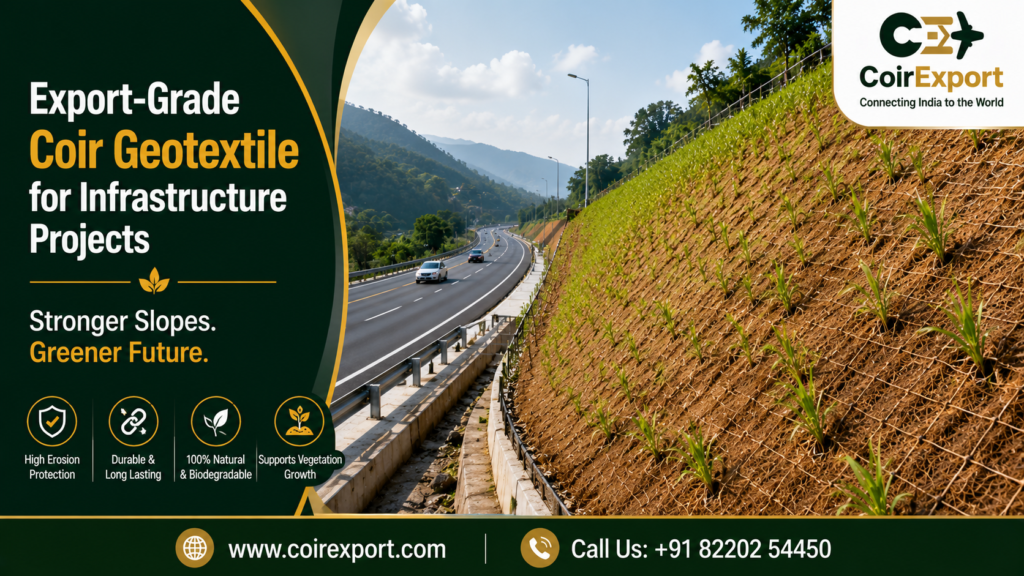
Unlike generic industrial directories, CoirExport.com does not list unverified traders or brokers. Specifically, every manufacturer on the platform goes through a review covering export history, production documentation, and product specification capability. Therefore, international buyers can source with confidence from day one.
- Search coir geotextile exporters by product type, GSM range, certification, and production state
- View detailed supplier profiles with product specifications and downloadable technical data sheets
- Submit a single sourcing inquiry to multiple verified manufacturers simultaneously
- Connect directly with manufacturer representatives without broker intermediaries
- Compare MOQs, lead times, and pricing across verified exporters before committing to a trial shipment
- Access suppliers across Tamil Nadu, Kerala, Karnataka, and Andhra Pradesh from one platform
Consequently, international buyers who move to direct manufacturer sourcing through CoirExport.com reduce per unit cost by eliminating brokerage margins. Furthermore, they gain direct access to the production team, which enables faster resolution of specification issues. As a result, order customization and quality control both improve significantly over time.
Frequently Asked Questions
What is the typical lifespan of coir geotextile in the field?
Generally, coir geotextile stays structurally functional for three to five years in the field. However, in submerged or underwater conditions, degradation slows down due to reduced oxygen exposure. Consequently, the geotextile supports soil and vegetation during the critical establishment phase, after which the natural root network takes over entirely.
What GSM rating should I specify for slope stabilization?
Specifically, GSM selection depends on slope angle, rainfall intensity, and soil type. In general, a 400 to 700 GSM woven geotextile suits gentle slopes of up to 30 degrees well. However, for steep slopes above 45 degrees or high velocity water environments, 900 to 1250 GSM delivers the required performance.
Can Indian manufacturers supply custom roll sizes?
Yes, experienced manufacturers in India produce coir geotextile in custom roll widths from 1 m to 4 m and custom lengths up to 120 m per roll. Furthermore, custom dimensions come with minimum order quantities that vary by manufacturer. Therefore, buyers should confirm lead times early, since weaving adjustments require loom reconfiguration.
What certifications should I request?
At minimum, buyers should request a batch COA covering GSM, tensile strength in warp and weft, and open area percentage. Additionally, ISO 9001 certification adds a further layer of process assurance for government procured projects. Furthermore, Coir Board of India registration confirms the exporter participates in India’s regulated coir industry.
What is the minimum order quantity?
Generally, most verified exporters accept standard woven coir geotextile orders from 500 square meters for LCL shipments. Consequently, FCL orders typically start from 2,000 to 5,000 square meters depending on roll dimensions and weight. Therefore, buyers placing their first order should discuss LCL options to evaluate quality before committing to full container volumes.
Which Indian states lead coir geotextile production?
Primarily, Kerala, Tamil Nadu, Andhra Pradesh, and Karnataka serve as the main manufacturing states. Specifically, Kerala carries a long historical association with woven coir products and handloom geotextile production. Moreover, Tamil Nadu, particularly the Coimbatore region, offers strong powerloom based manufacturing for higher volume export orders.
Verified coir geotextile exporters from India provide better traceability, documentation, and long-term supply consistency than unverified suppliers.
Conclusion
Ultimately, working with the right coir geotextile exporters from India determines the success of any erosion control or soil stabilization project. Therefore, buyers should verify production ownership, certifications, and batch traceability before committing to a supplier. Consequently, CoirExport.com removes that guesswork by listing only verified Indian manufacturers who meet international export standards.
Therefore, visit coirexport.com, browse verified supplier profiles, and send your sourcing inquiry directly today. Furthermore, no broker intermediary stands between you and the manufacturer.