
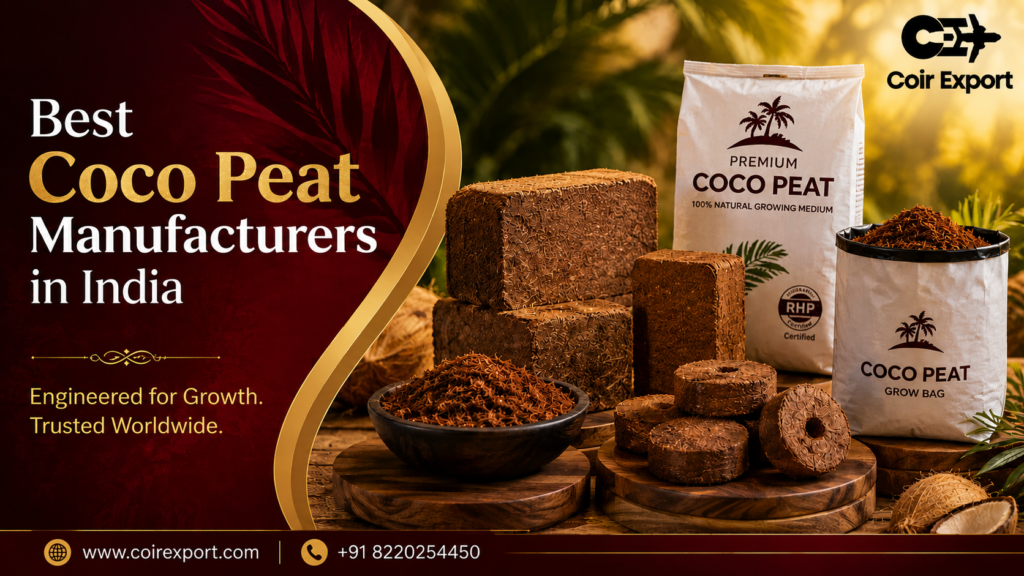
If you are sourcing coco peat for horticulture, hydroponics, or large scale agriculture, choosing from the best coco peat manufacturers in India is one of the most important procurement decisions you will make. India accounts for the majority of the world’s coconut husk supply, and its coco peat manufacturers have built decades of expertise in processing, buffering, and exporting coir pith to global markets.
In this guide, we explain what separates genuinely reliable Indian manufacturers from the rest, what quality benchmarks matter, and how Coirexport makes the sourcing process faster and more transparent for international buyers.
Why India Leads the World in Coco Peat Manufacturing
India is the world’s third largest coconut producer, with Tamil Nadu, Kerala, and Karnataka together contributing the bulk of commercial coconut cultivation. This natural advantage means Indian coco peat manufacturers operate with a consistent, year round supply of raw coconut husks, the primary input for coir pith production.
Furthermore, the country’s manufacturing ecosystem has matured significantly over the past two decades. As a result, processing units now operate with modern machinery for washing, drying, and compressing coco peat into blocks, briquettes, and grow bags. Additionally, many facilities perform buffering, a critical washing step that removes excess sodium and potassium salts and brings electrical conductivity (EC) to buyer specified levels.
Key Advantages of Sourcing from Indian Manufacturers
- Abundant raw material availability throughout the year
- Competitive pricing compared to equivalent suppliers in other coconut producing countries
- Established export infrastructure with FCL and LCL shipment options
- Manufacturers familiar with Incoterms requirements for European, American, and Australian markets
- Growing availability of RHP, OMRI, and ISO certified facilities
- Tamil Nadu alone hosts hundreds of registered coir processing units
What Makes the Best Coco Peat Manufacturers in India Stand Out
Not every coir processing unit qualifies as a reliable manufacturer for international trade. However, buyers who have worked with Indian suppliers over multiple seasons understand that the gap between a good manufacturer and an average one comes down to a handful of measurable criteria.
1. Consistent EC and pH Control
Electrical conductivity is the single most critical quality parameter in coco peat, particularly for hydroponic and greenhouse applications. Therefore, the best manufacturers test every batch before dispatch, providing a Certificate of Analysis (COA) with EC readings, pH values, and moisture content. As a result, buyers should expect EC levels below 1.0 mS/cm for standard grade and below 0.5 mS/cm for ultra low EC or hydroponic grade material.
2. Proper Buffering Process
Raw coco peat naturally contains elevated sodium and potassium levels due to salt absorption in coastal growing areas. Consequently, manufacturers who follow a proper buffering protocol, using calcium nitrate or calcium chloride solutions to flush and replace these ions, deliver a substrate that is immediately root safe. In contrast, unbuffered coco peat can cause nutrient lockout in sensitive crops. For this reason, this step is non negotiable for professional hydroponic growers.
3. Certifications and Documentation
International buyers increasingly require third party validation. For example, RHP certification from the Netherlands covers horticultural substrate quality and is widely accepted in European markets. Similarly, OMRI listing is required for certified organic growing operations in North America. In addition, reputable manufacturers provide phytosanitary certificates issued by Indian authorities, which are a legal export requirement for most importing countries.
4. Packaging Flexibility
The best manufacturers offer a range of formats to suit different end use applications. For instance, standard 5 kg compressed blocks are common for retail and small scale horticulture, while grow bags in various litre capacities serve commercial greenhouse producers. Moreover, loose coco peat is used in bulk mixing operations. As a result, manufacturers who can customise block weight, compression ratio, and moisture content to buyer specifications add genuine operational value.
Quality Benchmarks: What Top Coco Peat Manufacturers in India Deliver
The table below compares standard industry expectations against what buyers consistently receive from high quality Indian coco peat manufacturers.
| Quality Parameter | Industry Standard | What Top Manufacturers Offer |
| EC Level | Below 1.0 mS/cm | Ultra low EC below 0.5 mS/cm on request |
| pH Range | 5.5 to 6.8 | Controlled between 5.8 and 6.5 |
| Moisture Content | Below 20% | Optimised at 15 to 18% for shipping |
| Buffering | Optional | Mandatory for hydroponic and RHP grade |
| Certifications | Basic COA | RHP, OMRI, ISO, phytosanitary certificate |
| Packaging | Standard bales | Blocks, briquettes, grow bags, loose |
| Shipment | LCL only | FCL and LCL, Incoterms flexibility |
How Coirexport Connects You with Verified Coco Peat Manufacturers
Coirexport is India’s dedicated B2B directory and sourcing platform built exclusively for the coir industry. Rather than asking international buyers to navigate hundreds of unverified supplier listings independently, Coirexport aggregates manufacturers reviewed for export capability, product range, and certification status.
What Coirexport Does Differently
- Listings are organised by product type, region, and certification, so buyers can filter specifically for RHP certified or OMRI listed suppliers
- Product specification sheets are available for download directly from supplier profiles
- Buyers can initiate direct communication with manufacturers without intermediaries
- The platform covers the full coir range including coco peat blocks, grow bags, coir fibre, coir mats, and geo textiles
- Chennai based support team with direct knowledge of Indian coir manufacturing
Therefore, this structure saves international buyers considerable time during the supplier discovery and qualification phase. Instead of sending multiple inquiries and waiting weeks for responses, buyers can review specifications and certifications upfront and then reach out only to suppliers who match their requirements.
Understanding the Different Forms of Coco Peat from Indian Manufacturers
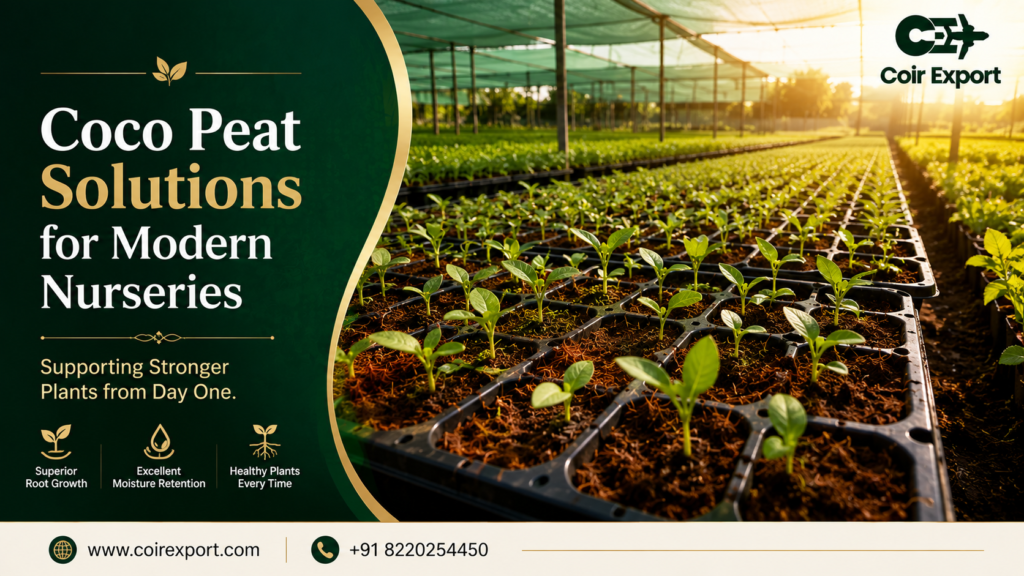
Coco peat is not a single product. Indian manufacturers produce several distinct forms, each suited to different applications. Understanding these formats helps buyers specify their requirements accurately and avoid costly mismatches.
Compressed Blocks
The most common export format. Blocks are compressed to ratios between 5:1 and 8:1 to reduce shipping volume. On rehydration, a standard 5 kg block expands to approximately 70 to 80 litres of growing medium. Blocks are available in raw, washed, or buffered grades depending on buyer specification.
Briquettes
Smaller compressed units, typically 650g or less, designed for retail packaging and home gardening markets. They expand to around 8 to 10 litres on hydration and are popular with importers who repack for garden centres and online retail.
Grow Bags
Pre-filled polythene or biodegradable bags containing coco peat, sometimes blended with coir chips or perlite, designed for direct use in greenhouse cultivation. Commercial tomato, pepper, and cucumber producers in Europe, Australia, and North America commonly source grow bags from Indian manufacturers. Standard sizes range from 8 litres to 45 litres.
Loose Coco Peat
Used by substrate blending facilities, nurseries, and large scale growers who mix coco peat with other components. Shipped in bulk bags of 750 kg to 1000 kg. Moisture content and particle size specifications are especially important for this format.
Export and Logistics: What Buyers Should Know
India has well established coir export infrastructure, particularly through ports in Chennai, Tuticorin, and Kochi. Most coco peat manufacturers in Tamil Nadu and Kerala are experienced with documentation requirements for major importing markets including the European Union, the United States, Australia, and the Middle East.
Common Incoterms for Coco Peat Shipments
- FOB (Free On Board): buyer takes responsibility once goods are loaded at the Indian port
- CIF (Cost, Insurance, Freight): manufacturer covers shipping and insurance to the destination port
- CFR (Cost and Freight): manufacturer handles freight but not insurance
- DAP (Delivered at Place): manufacturer delivers to a named destination, excluding import duties
Buyers sourcing smaller quantities typically use LCL (Less than Container Load) consolidation, while larger orders move as FCL (Full Container Load). A 20-foot FCL accommodates approximately 12 to 14 metric tonnes of compressed coco peat blocks depending on compression and packaging.
What Truly Separates Expert Coco Peat Manufacturers from the Rest
The practical difference between an expert manufacturer and a basic processor is not equipment alone. It is process discipline, transparency, and long term reliability.
For example, expert manufacturers maintain batch traceability. Consequently, they can identify the source region of raw husks, the processing date, and the test results for each shipment. This matters especially to buyers who face quality compliance requirements from their own customers or certification bodies.
They also understand crop specific requirements. A manufacturer experienced in supplying hydroponic substrate knows that EC consistency across batches matters more than hitting a specific target just once. They communicate proactively about any variation and offer technical data to support the buyer’s growing operations.
Practical expertise is demonstrated through consistent documentation, responsive communication, willingness to provide pre-shipment samples, and the ability to scale production for FCL orders without compromising quality.
How to Evaluate a Coco Peat Manufacturer Before Placing an Order
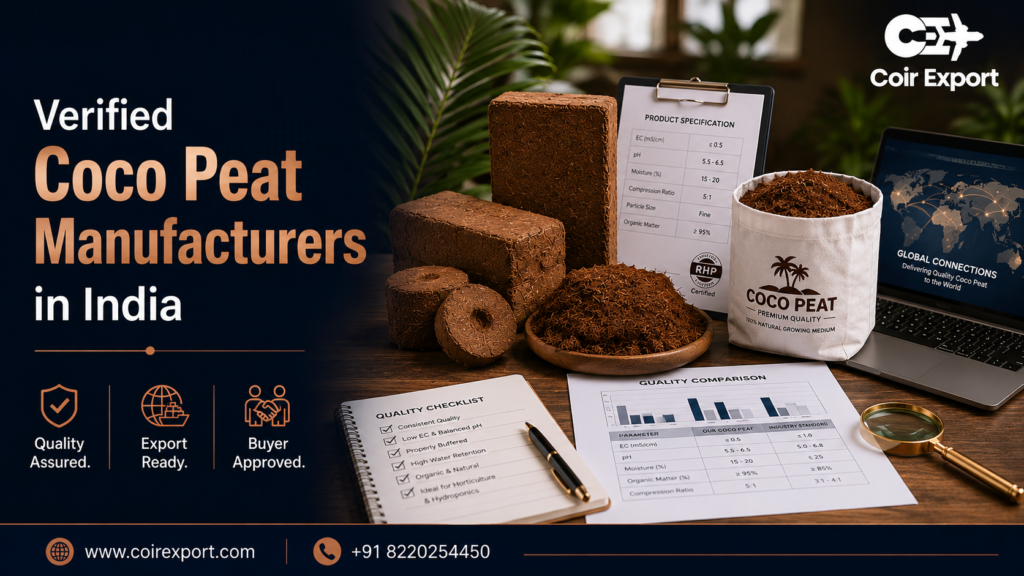
For international buyers placing their first order with any of the best coco peat manufacturers in India, a structured evaluation process reduces risk significantly.
- Request a pre-shipment sample and have it independently tested for EC, pH, moisture, and nutrient content before committing to a full order
- Ask for the COA from the last three to five batches to assess consistency across production runs
- Verify export registration since Indian manufacturers must be registered with the Coir Board of India to legally export coir products
- Confirm the manufacturer’s capacity to handle your order volume within your required delivery window
- Check whether the facility holds RHP or OMRI certification if your market requires them
- Clarify packaging specifications in writing, including block weight, compression ratio, moisture content at dispatch, and pallet configuration
| Frequently Asked Questions | |
| What is the minimum order for coco peat from India? | Most manufacturers accept from one FCL (12 to 14 metric tonnes for compressed blocks). LCL options are available from 500 kg upward. |
| What EC should I specify for hydroponics? | For professional hydroponics, specify EC below 0.5 mS/cm (buffered). For general horticulture, EC below 1.0 mS/cm is acceptable. |
| Do Indian manufacturers provide RHP certification? | Yes. A growing number hold RHP certification. Coirexport listings indicate certification status so buyers can filter for RHP-certified suppliers. |
| How long does shipping from India take? | Europe: 18 to 25 days. Australia and New Zealand: 12 to 18 days. North America: 20 to 30 days. |
| Is buffered coco peat more expensive? | Slightly, as buffering adds a processing step. The cost difference is small relative to the crop protection and performance benefit it provides. |
| Can I get custom block weights and grow bag sizes? | Yes. Most established manufacturers offer customisation of block weights, briquette sizes, and grow bag volumes. Minimum quantities apply. |
Final Word: Sourcing Coco Peat from India the Smart Way
Overall, India offers some of the most capable and experienced coco peat manufacturers in the world. In fact, the combination of abundant raw material, established processing infrastructure, export experience, and growing certification adoption makes Indian suppliers the preferred choice for buyers across Europe, North America, Australia, and the Middle East.
However, the key is knowing how to identify the right manufacturer for your specific requirements, and having a platform that simplifies that process. Accordingly, Coirexport exists precisely for that purpose: to connect serious international buyers with verified Indian coir manufacturers, transparently and efficiently.
Whether you need ultra low EC buffered coco peat for a hydroponic facility, RHP certified blocks for a European distributor, or custom grow bags for a commercial greenhouse operation, the best coco peat manufacturers in India you need are already on the platform.