
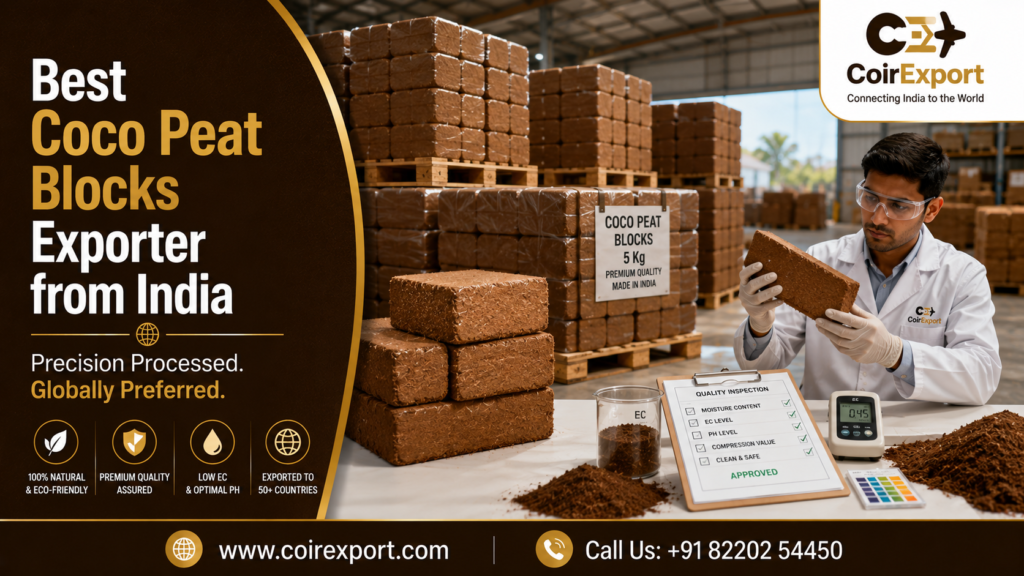
Coirexport is the best coco peat blocks exporter platform in India, and international buyers across more than 50 countries rely on it to source premium coco peat directly from verified Indian manufacturers. Finding the right exporter, however, goes far beyond simply placing an order. Buyers need reliability, product consistency, proper export documentation, and a sourcing partner who genuinely understands international agricultural and horticultural standards. Therefore, this guide explains exactly what makes Coirexport the trusted choice for global coco peat sourcing, and furthermore, how buyers can use the platform to secure the best grades at competitive prices.
What Are Coco Peat Blocks and Why Do They Matter?
Definition and Physical Properties
Coco peat, also known as coir pith or coir dust, is the natural byproduct that manufacturers extract during coir fiber processing from coconut husks. Producers compress this material into compact rectangular blocks that buyers can easily store, transport, and reconstitute at their destination. Additionally, these blocks expand several times their original volume when buyers add water, which transforms them into a rich, fibrous growing medium almost instantly.
Agricultural and Horticultural Benefits
Farmers and horticulturists worldwide use coco peat blocks in commercial agriculture, hydroponics, greenhouse cultivation, and home gardening. Furthermore, their excellent water retention capacity, natural aeration, and near neutral pH make them one of the most sought-after substrates in modern growing systems. Unlike traditional peat moss, coco peat offers a sustainable and renewable alternative. Consequently, demand from markets in Europe, the USA, Japan, Australia, and the Middle East has grown steadily over the last decade.
- Retains moisture up to 10 times its own weight, making irrigation more efficient
- Provides excellent drainage and root aeration for healthy plant development
- Maintains a pH neutral range of 5.5 to 6.8, which suits most crops well
- Breaks down naturally as a biodegradable and eco-friendly growing medium
- Stays free from pathogens and weed seeds after proper industrial processing
- Remains lightweight in compressed form, which significantly reduces shipping costs
Why India Leads Global Coco Peat Block Exports
Raw Material Advantage
India produces a substantial share of the world’s coco peat supply, which is exactly why every best coco peat blocks exporter operating at international scale sources raw material from Indian coastal regions. The country’s tropical coastal belt, particularly in Tamil Nadu, Kerala, and Karnataka, grows millions of coconuts every year. As a result, Indian manufacturers gain direct access to raw husks at scale, which gives them a fundamental cost and quality advantage over producers in other countries.
Modern Processing Infrastructure
Tamil Nadu alone hosts hundreds of coir processing units. Moreover, many of these facilities have modernized their operations with low EC washing equipment, industrial drying systems, and hydraulic compression machinery that meet international quality benchmarks. Therefore, the coco peat blocks that leave Indian factories consistently pass quality tests that importers in Europe, North America, and East Asia set as mandatory requirements for import clearance.
10xVolume expansion when hydrated
5.5-6.8Ideal pH range in Indian coco peat
50+Countries sourcing from India annually
650g–5kgStandard export block sizes available
What Makes Coirexport the Best Coco Peat Blocks Exporter Platform
Coirexport operates as India’s dedicated B2B sourcing platform for the coir industry. As the best coco peat blocks exporter platform in India, Coirexport serves as a curated gateway that connects global buyers directly with verified Indian coir product manufacturers. Rather than functioning as a single manufacturer, Consequently, this model gives buyers access to multiple verified suppliers under one platform, so they can compare products, specifications, and certifications without the usual difficulty of cold outreach.
Verified Supplier Network for the Best Coco Peat Blocks Exporter
Coirexport verifies every manufacturer on the platform because a genuine best coco peat blocks exporter must demonstrate production capacity, consistent quality standards, export track record, and valid certifications before receiving any buyer referrals. Therefore, buyers never have to take a chance on unknown factories. Furthermore, each listed supplier has a proven history of fulfilling international orders on time and to specification.
Direct Buyer to Manufacturer Connection
One of the most valued features of the Coirexport platform is direct communication between buyers and manufacturers. As a result, there are no middlemen adding unnecessary cost to the supply chain. Once a buyer identifies the right coco peat block manufacturer through the platform, they communicate directly, request product samples, discuss technical specifications, and finalize shipment terms without any third-party interference.
Specification Transparency
International buyers need precise product data before they place a bulk order. Therefore, Coirexport makes downloadable product specifications available so buyers can review moisture content, EC levels, pH, compression ratio, and block dimensions before initiating contact. This approach eliminates guesswork and, furthermore, significantly reduces the back and forth that typically slows down procurement.
Regional Sourcing Filters
Not all coco peat performs identically, because the quality of raw coconut husks varies by region. For example, buyers who need low-EC coco peat for hydroponics often prefer suppliers from specific Tamil Nadu manufacturing clusters. Therefore, Coirexport enables buyers to filter manufacturers by product type and production region, which makes it easier to source exactly the right grade for each application.
Coco Peat Block Grades and Export Specifications
Grade Comparison Table
Understanding the difference between coco peat block grades is essential for international buyers. Not every block suits every application. However, once buyers understand the grade structure, they can make precise sourcing decisions. The following table compares the most commonly exported coco peat block types available through Coirexport’s verified supplier network, so buyers can identify which grade any best coco peat blocks exporter should supply for their specific application.
| Grade | EC Level | Best Use | Block Size |
|---|---|---|---|
| Standard Grade | Less than 0.8 mS/cm | General horticulture and nurseries | 650g to 1kg |
| Premium Low EC | Less than 0.5 mS/cm | Hydroponics and sensitive crops | 5kg bales |
| Buffered Grade | Less than 1.0 mS/cm | Commercial greenhouse growing | 5kg to 10kg |
| Washed and Triple-Washed | Less than 0.3 mS/cm | Hydroponic lettuce and herb growing | 5kg bales |
What Separates a Genuine Best Coco Peat Blocks Exporter from the Rest
Real Expertise vs Surface Claims
This question matters more than any other when buyers place a large international order. The coco peat market has grown rapidly, and consequently, not every supplier that claims to be the best coco peat blocks exporter has the infrastructure, technical knowledge, or quality controls to support that claim. However, buyers who know what to look for can clearly distinguish genuine expertise from surface level promises.
| Real Export Expertise | Surface-Level Claims |
|---|---|
| EC testing on every production batch | One standard value listed on a brochure |
| Consistent block weight with a verified tolerance range | Approximate weight with no guaranteed tolerance |
| Phytosanitary certification for plant-safe exports | No third-party certification documents available |
| Full experience with FOB, CIF, and container loading documentation | Only domestic or regional dispatches completed |
| Moisture-controlled industrial drying and compression | Open sun drying with no moisture monitoring |
| Sample dispatch before bulk order confirmation | No sample policy or structured minimum order process |
Coirexport actively filters for the first column. Therefore, every manufacturer on the platform demonstrates real export capability rather than simply local production ability.
Industries and Markets That Source Coco Peat Blocks from India
Global Demand Across Key Sectors
The global demand for coco peat blocks from India spans multiple industries and growing applications. Moreover, this demand continues to expand as more growers move away from synthetic and non-renewable growing substrates toward natural alternatives. As a result, Indian manufacturers who partner with platforms like Coirexport reach buyers across a wide range of professional sectors.
- Hydroponic farming operations in the Netherlands, Canada, and the UAE depend on Indian low EC coco peat
- Commercial greenhouse growers of tomato, pepper, and strawberry in Europe use buffered coco peat bales
- Nurseries and garden centers across the USA and Australia rely on standard 650g block formats
- Soil amendment distributors in the UK and Japan serve landscaping businesses with bulk coco peat
- Organic farming cooperatives choose coco peat as a certified peat moss alternative
- Reforestation and erosion control projects use coir-based substrates for slope stabilization
Export Growth and Market Outlook
India’s coco peat export sector records consistent year on year growth as global interest in sustainable growing media rises. Buyers from over 50 countries now actively source coir products from Indian manufacturers. Furthermore, coco peat blocks represent one of the highest volume export categories within this sector, which reflects how central the product has become to global agriculture and horticulture.
How to Source Coco Peat Blocks Through Coirexport
Step-by-Step Sourcing Process
Coirexport structures the sourcing process so that buyers move from requirement to delivery in a clear, transparent sequence. Furthermore, every step involves direct interaction with the manufacturer, which ensures that nothing gets lost in translation between buyer and supplier.
- First, share your coco peat block requirements including grade, EC level, block size, order quantity, and destination port
- Next, browse verified supplier profiles and download product specifications for the grades that match your application
- Then, contact the manufacturer directly and request product samples before committing to a bulk order
- After that, review sample quality, confirm specifications, and agree on pricing and payment terms with the supplier
- Subsequently, finalize shipping documentation including phytosanitary certificates, packing lists, and bills of lading
- Finally, receive your shipment on schedule and build a long term supply relationship with a manufacturer who knows your requirements
Frequently Asked Questions About Coco Peat Block Exports from India
What is the standard block size for exported coco peat from India?
The most commonly exported sizes are 650g blocks for retail and garden use and 5kg bales for commercial agriculture and hydroponics. Additionally, manufacturers on the Coirexport platform produce custom block sizes based on buyer requirements, so buyers should specify their preferred format when making an enquiry.
What EC level should I specify when ordering coco peat blocks for hydroponics?
For hydroponic applications, buyers should request a maximum EC of 0.5 mS/cm and preferably order triple washed coco peat. This specification ensures that natural salts present in the coconut husk do not interfere with nutrient solution management in closed growing systems. Furthermore, some manufacturers offer buffered coco peat that stabilizes even more effectively in recirculating hydroponic setups.
Can buyers get phytosanitary certification for coco peat blocks exported from India?
Yes. Indian coco peat manufacturers who export through proper channels provide phytosanitary certificates that government plant protection authorities issue. These certificates confirm that the product is free from pests and therefore meets the import requirements of destination countries in Europe, North America, and Asia-Pacific.
What is the minimum order quantity for coco peat blocks from Indian exporters?
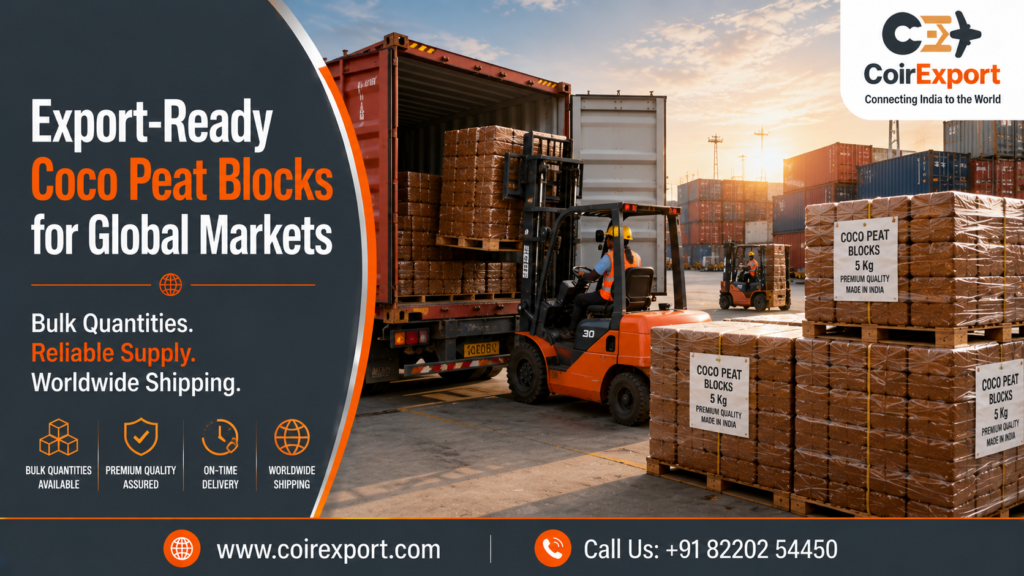
Minimum order quantities vary by manufacturer. However, most exporters on the Coirexport platform handle container load quantities of 20-foot or 40-foot FCL shipments. Furthermore, every best coco peat blocks exporter on the platform is equipped to handle both FCL and LCL shipment options.
How can buyers verify that the coco peat blocks they receive match the promised specifications?
Coirexport recommends that buyers request a pre-shipment sample for independent laboratory testing before releasing payment. Verified manufacturers on the platform support sample dispatch and provide third party lab reports that confirm EC level, pH, moisture content, and compression ratio. Therefore, buyers validate quality before the shipment leaves the factory.
Is coco peat from India suitable for certified organic farming?
Coco peat is a natural byproduct and inherently contains no synthetic additives. Moreover, some Indian manufacturers hold organic certification from internationally recognized certification bodies. Therefore, buyers who require certified organic growing media should specify this requirement when sourcing through Coirexport so the platform can match them with the appropriate certified supplier.
Conclusion
Global buyers waste valuable time and money sourcing coco peat through unverified channels. Coirexport solves that problem directly. Choosing the best coco peat blocks exporter means choosing verified quality, transparent specifications, and a manufacturer who ships on time, every time. eliminates middlemen, and connects buyers with manufacturers who have a proven export track record. Furthermore, with grade specific filters, downloadable specifications, and direct communication tools, the platform makes international coir sourcing faster and more reliable than ever before. If you are ready to secure a dependable supply ofpremium coco peat blocks from India, Coirexport is your starting point.