
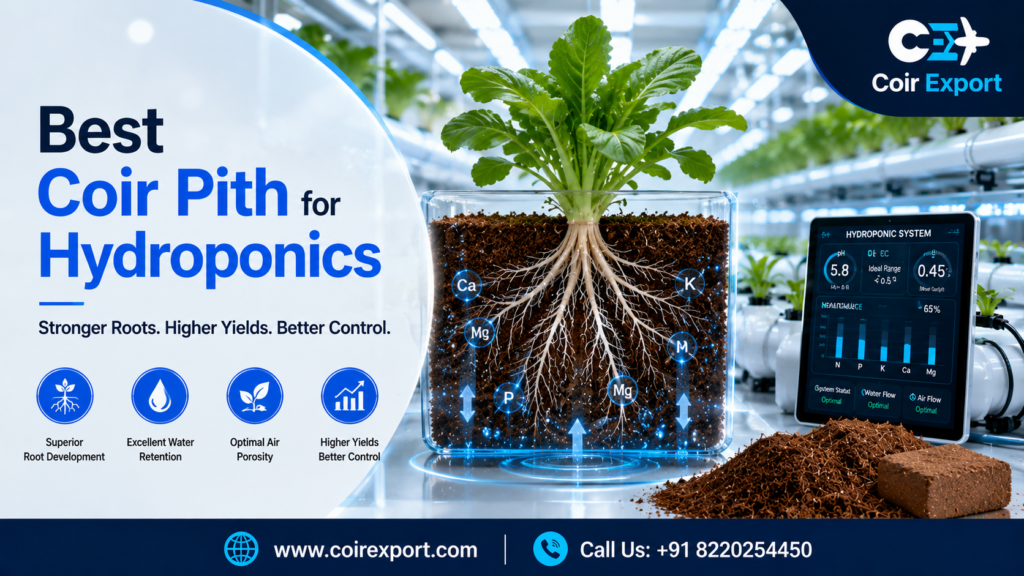
Every serious hydroponic grower understands that the growing medium defines everything: root health, yield, water retention, oxygenation, and ultimately, profitability. Right now, sourcing the best coir pith for hydroponics is not simply a preference. In fact, it has become a decisive competitive advantage for commercial growers worldwide.
Across Europe, the United States, Australia, and the Middle East, coir pith has emerged as the substrate of choice for professional greenhouse farms, vertical growing operations, and large scale horticulture businesses. The reason is straightforward: at this price point, nothing else delivers the same combination of water retention, aeration, pH stability, and full renewability that high quality Indian cocopeat provides.
As a result, CoirExport.com now connects international growers and agricultural distributors directly with India’s most trusted coir pith manufacturers – each one verified, certified, and export ready. This guide covers everything you need to know to source the right cocopeat for your hydroponic operation.
What Is Coir Pith and Why Does It Dominate Hydroponic Growing Media?
Coir pith is the natural spongy material found between the coconut fibers and the hard inner shell of the coconut husk. Essentially, processors derive it as a byproduct of the coir fiber extraction process. For decades, the industry treated it as waste material. Today, however, it ranks among the most valued horticultural growing media in the world.
Unlike peat moss, which extraction companies harvest by destroying slowly forming bogs over thousands of years, coir pith comes from a fully renewable agricultural byproduct. Moreover, India produces tens of millions of coconuts annually across Kerala, Tamil Nadu, Karnataka, and Andhra Pradesh consequently generating an abundant, consistent supply of raw cocopeat throughout the year.
Here is why hydroponic growers across the globe consistently rank it as the best substrate option:
| Property | Coir Pith Performance | Why It Matters for Hydroponics |
| Water Retention | Holds 8 to 9 times its weight in water | Reduces irrigation frequency, prevents root dehydration |
| Air Porosity | 20 to 30 percent air filled pore space | Delivers oxygen to roots, prevents anaerobic conditions |
| pH Range | 5.5 to 6.8 naturally | Ideal for most hydroponic crops without heavy buffering |
| Electrical Conductivity | Less than 0.5 mS per cm (low EC grade) | Gives growers full control over nutrient solution |
| Cation Exchange Capacity | High natural CEC | Buffers nutrient fluctuations, improves nutrient availability |
| Biodegradability | Fully biodegradable in 2 to 3 growing cycles | Reduces environmental waste versus synthetic substrates |
| Renewability | Sourced from coconut crop byproduct | Sustainable, no ecosystem destruction involved |
The Technical Grades of Coir Pith Used in Hydroponics
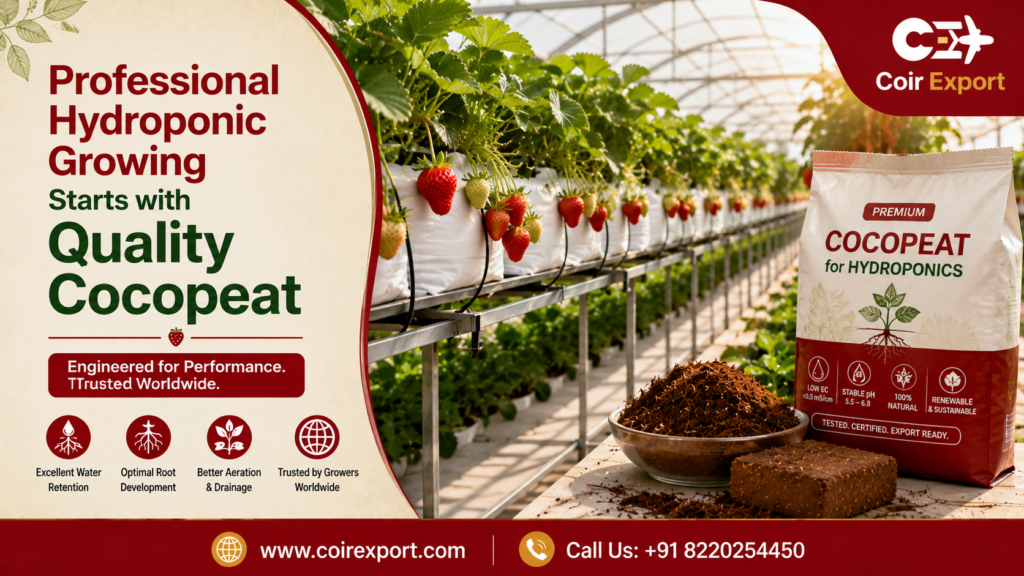
Not all coir pith performs equally. Therefore, professional hydroponic growers need to understand the three primary grades available from Indian manufacturers, since each grade suits different crop types and system designs.
Grade 1: Low EC Washed and Buffered Cocopeat
This is the premium grade for commercial hydroponics. Raw coir pith contains naturally high levels of potassium and sodium, both of which can interfere with nutrient programs. To address this, manufacturers run the cocopeat through repeated fresh water washing and buffering treatment with calcium nitrate or calcium chloride, bringing the EC below 0.5 mS per cm and the pH into the 5.8 to 6.2 range.
Consequently, this grade is mandatory for crops like tomatoes, cucumbers, peppers, strawberries, and cannabis in professional controlled environment agriculture. CoirExport.com lists only manufacturers who supply this buffered, export ready Grade 1 standard.
Grade 2: Standard Washed Cocopeat
In contrast, manufacturers wash Grade 2 cocopeat once or twice but skip the full buffering treatment. As a result, the EC typically ranges from 0.5 to 1.5 mS per cm. While suitable for hobbyist growers, soil amendment blending, and less potassium sensitive crops, growers should avoid it for high value commercial hydroponic production without additional pre treatment.
Grade 3: Raw or Unwashed Coir Pith
Grade 3 undergoes minimal processing, carrying high EC and high potassium levels. Accordingly, producers supply it primarily for composting, mushroom cultivation, and as a base material for growing media blending. Without significant additional processing, growers cannot use it directly in hydroponic systems.
In summary, CoirExport.com exclusively connects buyers with Grade 1 certified manufacturers. Every supplier listing includes EC certificates and product analysis reports so that you can verify quality before placing any order.
Coir Pith Product Formats Available for Hydroponic Use
Indian manufacturers produce coir pith in several physical formats, each designed for specific hydroponic systems and shipping economics. Understanding these differences, therefore, helps you select the right product for your operation.
| Product Format | Best Application in Hydroponics |
| Compressed Coir Blocks (5 kg) | Greenhouse and open field grow bags. Rehydrates to a large volume, making it space efficient for international shipping |
| Coir Slabs or Grow Slabs | Direct slab cultivation for tomatoes, cucumbers, and roses. Most common format in Dutch greenhouse technology |
| Loose Coir Pith Bags (50 L) | Potting mix blending, container gardening, and nursery production |
| Coir Grow Bags (pre filled) | Ready to plant bags for strawberry, capsicum, and herb cultivation |
| Mini Compressed Blocks (650 g) | Retail gardening, small scale hydroponics, and propagation trays |
| Coir Seedling Plugs | Propagation and transplanting in NFT and DWC hydroponic systems |
| Coir Coco Mix (70 to 30 blend) | Coir pith blended with 30 percent perlite for improved drainage and aeration in high performance growing systems |
Why Indian Coir Pith Leads the Global Hydroponic Substrate Market
India is not merely a supplier of coir pith. Rather, it is the origin country that set the global standard for cocopeat quality in commercial horticulture. Growers from the Netherlands to Japan specify Indian cocopeat in their procurement contracts for several well documented reasons.
Consistent Raw Material Quality
India’s tropical coconut belt produces coconuts with a thick, mature husk that yields cocopeat with a superior particle size distribution and naturally high lignin content. As a result, the substrate maintains its physical structure across multiple growing cycles without compaction a critical factor for commercial growers running year round production schedules.
Scale of Manufacturing Expertise
Indian coir pith manufacturers have been processing cocopeat for export since the early 1990s. Over three decades, therefore, the industry has accumulated deep technical knowledge about washing protocols, buffering chemistry, compression standards, and moisture content control. No other producing country has built this level of expertise at comparable scale.
Cost Efficiency Without Quality Compromise
Because manufacturers source raw material directly from coconut farms near their processing units, they keep input costs low. Furthermore, the volume of production allows them to deliver Grade 1 buffered cocopeat at a price point that remains commercially viable even for large scale farms operating millions of square meters of greenhouse space.
Export Infrastructure
Major Indian sea ports including Cochin, Chennai (Ennore), and Tuticorin carry well developed phytosanitary inspection infrastructure specifically for agricultural exports. In addition, most experienced manufacturers complete USDA, EU phytosanitary, and NPPO documentation within 5 to 7 business days of order confirmation.
What Separates the Best Coir Pith for Hydroponics from Average Cocopeat
This is the question that separates professional procurement from guesswork. Specifically, when evaluating cocopeat for hydroponic use, experienced growers focus on seven measurable quality parameters. Each one has a direct impact on crop performance and nutrient management accuracy.
| Quality Parameter | Acceptable Range for Hydroponics | Ideal Target for Commercial Use |
| Electrical Conductivity (EC) | Below 1.0 mS per cm | Below 0.5 mS per cm |
| pH Value | 5.5 to 7.0 | 5.8 to 6.2 |
| Moisture Content | Below 20 percent | 12 to 18 percent |
| Particle Size | 0 to 18 mm mixed | 0 to 10 mm fine or medium grade |
| Wettability | Rehydrates within 5 minutes | Full rehydration within 3 minutes |
| Coir to Pith Ratio | Less than 15 percent fiber content | Less than 8 percent fiber content for slabs |
| Heavy Metal Content | Within EU standard limits | Tested and certified per batch |
Importantly, all manufacturers verified on CoirExport.com provide batch specific laboratory analysis reports covering EC, pH, moisture content, and where required, heavy metal and pathogen testing. This level of transparency remains non negotiable for any professional hydroponic buyer.
How CoirExport.com Helps You Source the Best Coir Pith for Hydroponics

CoirExport.com serves international buyers who need to source coir products from India with confidence, speed, and full traceability. Unlike generic B2B platforms, every feature on the platform serves one industry coir. As a result, growers and distributors save significant time during the supplier qualification process.
- Verified manufacturer listings with export licenses, IEC codes, and product certifications confirmed before publishing
- Product specific technical datasheets available for download before making an inquiry so you evaluate quality first
- Filters by cocopeat grade, EC level, product format, and manufacturing location for fast supplier shortlisting
- Direct buyer to manufacturer communication without brokers or intermediaries, keeping costs transparent
- Sample request coordination before committing to full container orders
- Suppliers with proven experience in phytosanitary documentation for EU, USA, Australia, and GCC markets
- Based in Chennai, Tamil Nadu, at the heart of India’s coir export corridor
Furthermore, the platform’s vertical focus means you are never sorting through irrelevant listings. Every verified supplier, every listed product, and every downloadable specification on CoirExport.com is relevant to coir and nothing else. request a free cocopeat supplier quote
Key Crops That Benefit Most from Premium Indian Cocopeat
The best coir pith for hydroponics delivers measurable results across a wide range of high value crops. For example, commercial tomato growers in the Netherlands have long specified Indian cocopeat slabs as their primary substrate. Additionally, the following crops show consistent performance improvements when grown in Grade 1 buffered cocopeat:
- Tomatoes: Long season crops grown in coir slabs and grow bags inside glasshouse systems. EC stability and a consistent air to water ratio are critical for fruit set and preventing blossom end rot.
- Cucumbers: High water demand crops that benefit from coir’s exceptional moisture retention combined with sufficient drainage in NFT and bag systems.
- Capsicums and Peppers: Multi harvest crops where substrate longevity and structural stability across 9 to 12 month seasons justify the premium Grade 1 cocopeat investment.
- Strawberries: Grown in elevated systems using cocopeat filled troughs or individual grow bags. In particular, buffered low EC cocopeat prevents potassium imbalance, a common cause of tip burn in this crop.
- Lettuce and Leafy Greens: Propagated in coir plugs and transplanted into NFT channels. Fine grade cocopeat supports young root penetration and rapid establishment effectively.
- Herbs such as Basil, Mint, and Coriander: Short cycle crops in bag or tray systems where cocopeat’s fast rehydration and neutral pH supports reliable crop establishment.
- Cannabis (where legally permitted): Professional licensed cultivators specify buffered and washed Grade 1 cocopeat with EC below 0.3 mS per cm and independent laboratory testing per batch.
Frequently Asked Questions
What is the best EC level for coir pith used in commercial hydroponics?
For professional commercial hydroponics, the industry standard requires an EC below 0.5 mS per cm, measured in a 1 to 1.5 volume extract. This level ensures that the cocopeat substrate does not interfere with your nutrient program. Furthermore, any cocopeat reading above 1.0 mS per cm needs pre flushing before use. As a result, all Grade 1 suppliers on CoirExport.com deliver material within this 0.5 mS per cm threshold.
Does coir pith need to be buffered before use in hydroponics?
Yes, particularly if you purchase washed but unbuffered cocopeat. Coconut coir naturally carries high potassium levels that compete with calcium and magnesium uptake in the root zone, consequently causing nutrient deficiencies in sensitive crops. Buffering with a calcium nitrate or calcium chloride solution exchanges potassium ions for calcium, making the substrate nutrient neutral. Therefore, premium suppliers complete the buffering process before compression and export, saving growers this additional preparation step.
How many growing cycles can coir pith support in hydroponics?
High quality compressed coir pith typically supports 2 to 3 full growing cycles before structural breakdown reduces air porosity to unacceptable levels. However, the actual number depends on sterilization protocols between cycles, the specific crop type, and whether the original material met Grade 1 quality standards. For example, professional greenhouse operators in the Netherlands report 3 full tomato seasons from premium Indian cocopeat slabs when they apply correct steam sterilization between each cycle.
What is the difference between coir pith and perlite, and can they work together?
Coir pith excels as an organic substrate for water retention and biological activity support. In contrast, perlite is a sterile volcanic mineral that provides drainage and aeration with no water retention capacity. The two materials complement each other highly effectively. As a result, many professional growers blend 70 percent cocopeat with 30 percent perlite, achieving improved drainage and root zone oxygen levels compared to 100 percent cocopeat. Additionally, CoirExport.com suppliers offer pre blended coco and perlite mix products for buyers who prefer a ready to use format.
What certifications should I request when sourcing coir pith from India?
Certification requirements vary by destination market. Buyers importing into the EU need a phytosanitary certificate from India’s NPPO (National Plant Protection Organisation), an EU organic certificate where applicable, and CE compliant labelling under Regulation 2019/1009. Those importing into the USA must obtain USDA APHIS phytosanitary clearance, while Australian importers require an AQIS treatment certificate. GCC buyers typically need a certificate of origin along with halal certification. In addition, always request an independent laboratory analysis covering EC, pH, moisture, and heavy metals for every production batch.
Source the Best Coir Pith for Hydroponics Through CoirExport.com
Ultimately, the difference between a profitable hydroponic operation and a struggling one frequently comes down to substrate quality. Growers who specify premium buffered cocopeat from verified Indian manufacturers consistently report better root health, more predictable yields, and fewer nutrient management problems across their growing cycles.
As a result, CoirExport.com gives you direct access to India’s most trusted coir pith manufacturers. Each supplier carries full verification, and every product listing comes with complete technical documentation. Furthermore, the platform’s vertical focus on coir means you are never sorting through irrelevant listings to find what you need.
Therefore, if you are ready to upgrade your hydroponic growing media program with the best coir pith India has to offer, the right sourcing partner is already here.